top of page

Cuthbert's Golden Treasury of Word, Saying, Folk, Phrase & Quotation in Sri Lanka
Afterlife

Illustration. The victory, Rene Magritte. Public Domain.
TUK-TUK WISDOM
“Everyone needs to go to heaven, but no one likes to die”
SHEHAN KARUNATILAKA
“You are now. And you won’t be soon.”
SHEHAN KARUNATILAKA
“The afterlife is a tax office, and everyone wants their rebate.”
Anger

Illustration: Rene Magritte, The Ladder of Fire. Public Domain.
MAKE SOMEONE ANGRY IN SRI LANKAN ENGLISH
“Raise the devil.”
SUNIL YAPA
“But that was the thing with anger. That was the tricky thing about pain. Sometimes it was hiding around a corner just waiting to slice you from stomach to throat.”
Architecture

Illustration: The revealing of the present by Rene MagrittePublic Domain.
GEOFFRY BAWA
"Architecture cannot be totally explained but must be experienced."
Atheism

Illustration: Rene Magritte, The sensational news. Public Domain.
SHEHAN KARUNATILAKA
“For atheists, there are only moral choices.”
Baskets

Illustration. The Basket of Bread, Salvador Dali. Public Domain.
KARAKGEDIY
A portable wicker basket for catching fish in shallow streams, open at both ends and conical in shape.
KODE
A basket to remove earth or sand.
PIRIWEHIKADA
A load that was made up of PIRIWOHI - wicker baskets filled with provisions.
PIRIWEHIKADA
A wicker basket.
WATAPETTIYA
A circular flat basket for carrying ADUKKU (food in layers).
WATTIYA
A flat basket for carrying flowers.
Beggers

Illustration: Rene Magritte, The red model. Public Domain.
ROBERT KNOX’S KANDYAN PROVERB
"A beggar and a trader cannot be lost. Because they are never cut out of the way."
Birds

Illustration. Book to Birds, Salvador Dali. Public Domain.
A SRI LANKAN PROVERB
“The bird that flies from branch to branch will end up getting drenched.”
Bread

Illustration: The Bread Basket, Salvador Dali. Public Domain.
MUSIC BREAD
Choon paan – or music bread- signifies the coming of the choon paan man, accompanied by the drifting tunes of Beethoven’s Für Elise.
SAMANTHA SENEVIRATNE
"Keep an eye on the dough rather than the clock."
THARSHAN SELVARAJAH
“My bread is always made with love. Always smiling, always laughing, always singing,”
TIK-TOK
"In Sri Lanka, you don't go to the bakery… the bakery comes to you."
Bureaucracy

Illustration: Rene Magritte, Intermission. Public Domain.
ARTHUR C. CLARKE, RAMA II
"All bureaucracies are the same. They drain the life out of the truly creative people and develop mindless paper-pushers as their critical mass."
PHILIP GUNAWARDENA
"It is heartbreaking to see how some institutions have strayed from their original objectives, leading to mayhem and chaos."
SHEHAN KARUNATILAKA
“Typical government office. Take a number and sit down until you forget why you came.”
Caution

Illustration. The Son of Man, Rene Magritte. Public Domain.
TUK-TUK WISDOM
“Last warning, my friend”
Chillis

Illustration. Les Fanatiques, Rene Magritte. Public Domain.
MIRIS
Chillies that were given as rent to a landowner in feudal times.
Cloth

Illustration. Portrait of Enid Haldorn, Salvador Dali. Public Domain.
ALWALA-REDDA
A cloth fresh from the loom.
BANKALA WIYANA
A decorated cloth or curtain that was imported from Bengal.
ETIRILLA
Cloth spread on chairs or other seats as a sign of respect for a guest or feudal headman.
HELAYA
A piece of cloth of twelve cubits – in feudal times, a cubit was approximately equal to the length of a forearm.
IRATTUWA
A Tamil word for a local cloth originally made by the Mehebedde people, who are involved in cinnamon production.
KADAPAIYA
A long cloth bag or purse - also called OLONGUWA.
KANGAN
A black cloth given to attendants at funerals.
KOTAHALU
The cloth worn by a young female arriving at puberty, which fell under the responsibility of the family's dhobi in feudal times.
PAWADAYA OR PIYAWILLA
A cloth spread on the ground by the dhobi on duty for the KAPURALA to walk upon during the TEWAWA, the ceremony at the Temple of the Tooth. It was also more generally used to provide for the entry of a distinguished visitor into a house.
REDIPILI
Cloth made into curtains and coverings for a temple.
TADUPPUREDDA
A rough country-made cloth, which the tenants of the tom-tom beater caste gave as their annual offering to their overlords in feudal times
TUPPOTTIYA
A cloth that was ten yards long and worn round the waist in feudal times, most typically by a person from Kandy.
TUWAYA-TUNDAMFL
A towel provided by the TOM-TOM beater tenants as part of a service offering.
Conch Shells

Illustration. Shell, Salvador Dali. Public Domain.
HAKDURE
A service of blowing the conch-shell or horn in the daily service of a DEWALAYA.
HAKPALIHA
The carrying of the conch-shell and shield in procession was one of the feudal services of the tenants of temple villages.
RAKC-DIYA
A conch-shell.
Cricketing Wisdom
![COMMON SLOGAN
"Sri Lanka Jaya Wewa" (Victory to Sri Lanka)
KERRY O'KEEFFE ON CHAMINDA VAAS'S CONTRIBUTION TO AUSTRALIAN SLANG
“If someone has a cute figure, they are known to have a nice Chaminda.”
KUMAR SANGAKKARA
“Fans of different races, castes, ethnicities, and religions who together celebrate their diversity by uniting for a common national cause. They are my foundation, they are my family. I will play my cricket for them. Their spirit is the true spirit of cricket. With me are all my people. I am Tamil, Sinhalese, Muslim, and Burgher. I am a Buddhist, a Hindu, a follower of Islam and Christianity. I am today, and always, proudly Sri Lankan.”
KUMAR SANGAKKARA
"I am today, and always, proudly Sri Lankan."
KUMAR SANGAKKARA
"Every punch builds resilience."
KUMAR SANGAKKARA
"The game goes on."
RANGANA HERATH
“It's happened to me so many times - being dropped is my bread and butter.”
ROMESH GUNESEKERA
“The most appealing side-effect of Sri Lankan cricket from where I stand, shuffling words, has been linguistic.”
ROMESH GUNESEKERA
“Cricket fans all over the world probably have more in common with each other than with their fellow citizens. “
ROSHEN SILVA
“Before going to bat, praying is the best way to prepare.”
RUCHIRA MAHADEV
“Whenever the nation is suffering and in pain, it [cricket] works like a balm,” the 34-year-old said.
TRADITIONAL PHRASE DESCRIBING SRI LANKAN CRICKET
"Even if the ship sinks, the band keeps playing.”](https://static.wixstatic.com/media/de6870_34e89412493a49338826ae2fcd87e832~mv2.jpg/v1/fill/w_286,h_407,al_c,q_80,usm_0.66_1.00_0.01,enc_avif,quality_auto/Image-empty-state.jpg)
Illustration. The secret player by Rene Magritte. Publi Domain.
COMMON SLOGAN
"Sri Lanka Jaya Wewa" (Victory to Sri Lanka)
KERRY O'KEEFFE ON CHAMINDA VAAS'S CONTRIBUTION TO AUSTRALIAN SLANG
“If someone has a cute figure, they are known to have a nice Chaminda.”
KUMAR SANGAKKARA
“Fans of different races, castes, ethnicities, and religions who together celebrate their diversity by uniting for a common national cause. They are my foundation, they are my family. I will play my cricket for them. Their spirit is the true spirit of cricket. With me are all my people. I am Tamil, Sinhalese, Muslim, and Burgher. I am a Buddhist, a Hindu, a follower of Islam and Christianity. I am today, and always, proudly Sri Lankan.”
KUMAR SANGAKKARA
"I am today, and always, proudly Sri Lankan."
KUMAR SANGAKKARA
"Every punch builds resilience."
KUMAR SANGAKKARA
"The game goes on."
RANGANA HERATH
“It's happened to me so many times - being dropped is my bread and butter.”
ROMESH GUNESEKERA
“The most appealing side-effect of Sri Lankan cricket from where I stand, shuffling words, has been linguistic.”
ROMESH GUNESEKERA
“Cricket fans all over the world probably have more in common with each other than with their fellow citizens. “
ROSHEN SILVA
“Before going to bat, praying is the best way to prepare.”
RUCHIRA MAHADEV
“Whenever the nation is suffering and in pain, it [cricket] works like a balm,” the 34-year-old said.
TRADITIONAL PHRASE DESCRIBING SRI LANKAN CRICKET
"Even if the ship sinks, the band keeps playing.”
Dancers

Illustration. A panic in the Middle Ages, Rene Magritte. Public Domain.
BALIBAT GAMMEHELA
Performers of a particular type of devil-dance in Sri Lanka, whose five-day devil-dance ritual takes place after the conclusion of the Perahera. They are believed to be descendants of immigrants from the coast and are considered superior to ordinary YAKDESSA devil dancers.
BALIBAT NETIMA
A devil-dance performed for five days after the close of the Perahera by the BALIBAT GAMMEHELA, descendants of emigrants from the coastal areas, and considered in feudal times to be of a superior caste to the ordinary YAKDESSO (devil dancers).
BARAKOLAN
Large masks representing Kataragama Deviyo that are used in dancing at the Dewala Pereara.
GARA-YAKUMA
A devil dance that is performed at the close of important undertakings, such as the construction of elephant quarters for the Perehera.
HIROHI-NETIMA OR NIROGINETIMA.
A processional dance at the procession returning from the water cutting DIYAKEPIMA ceremony in the Badulla District.
KANKARIYA OR KOHOMBA YAK KANKARIYA
A Kandyan all-night healing dance ritual and one of the island’s classical historic dances that predates Buddhism. The story goes that it originated from a ritual performed to cure the ancient King, Panduwasdev. Beginning at dusk, and often involving over 50 dancers and drummers, it incorporates into its performance many cultural components, including the recitation of songs - Katha Paha.
KOLAN
Masks that are worn in dancing at DEWALA festivals.
NAYYANDI-NETIMA
The dance of the YAKDESSA devil-dancers during a Perehera.
PATTINI-NETUMA
A ritualistic dance dedicated to the Goddess Pattini, the guardian deity of fertility, health, and prosperity. Very popular in the southern and western regions of the island, it is done to secure divine protection against random epidemics and calamities. The dance – graceful and symmetrical – is accompanied by music and, though carried out by women, dates to the war dance performed by the very soldiers responsible for bringing the goddess’s sacred anklets to Sri Lanka from India.
SANNI-Y AKUMA
A type of devil dance enacted to propitiate demons afflicting a patient.
SHANTHIKARMA
A ritualistic folk performance believed to ward off evil influences, disease, or misfortune by invoking divine blessings. The word betrays its purpose - "Shanthi" (peace) and "Karma" (action). Hypnotic drumming, chanting, and vigorous dancing is carried out by performers bearing demon or Yaksha masks, often reciting dire stories that reinforce the benefits of best behaviour – and in so doing heal disease, dispel anxiety or fear), ensure good harvests, and bring peace. The rituals are divided into:
Yak Thovil (Devil Dancing) – to expel evil spirits that cause illness.
Bali Shanthikarma - rituals involving clay images to reduce the negative planetary influences.
Deva Thovil / Madu Shanthikarma - rituals to gain the protection of gods (Devas).
Kohomba Kankariya – a special Kandyan ritual that occurs after the harvest to invoke divine blessings
UL-UDE
Trousers worn by dancers.
WESMUNA
A mask worn at a Devil or other dance.
YAKDESSA
A traditional ritualist, dancer, or shaman who performs exorcism rituals to cure illnesses, ward off evil spirits, or appease demons (YAKU).
YAKDESSO
Devil dancers, or exorcists who conduct ceremonies aimed at curing illnesses and removing evil influences believed to be caused by demons. In addition to conducting THOVIL (exorcism ceremonies), they enact KANKARIYA (classical ritual dances). They are seen to act as intermediaries between the human world and the realm of demons and deities, using dance, music, and chanting to appease or repel YAKKHAS (demons).
Decorative Arches

Illustration. Atavistic Vestiges After the Rain, Salvador Dali. Public Domain.
EHELA-GAHA
A post or tree set up at a Dewale at a lucky hour in the month of EHELA as a preliminary to the Perahera, not unlike an English May-pole.
HARASKADAYA
A cross stick in an arch, supplied by tenants in feudal times for decorations at festivals.
KATUKITUL
Wild prickly kittul, the flowers of which are used in decorations.
KUMBAYA
A post, or a pole for arches with decorations.
ORAK-KODIA OR OSAKKODIYA
Small flags on arches or on sticks placed at intervals.
RELIPALAM
Cloth decorations on an arch and tied to form a kind of frill.
TORANA
An ornamental arch that is put up on public and festive occasions.
Dhobis & Washing
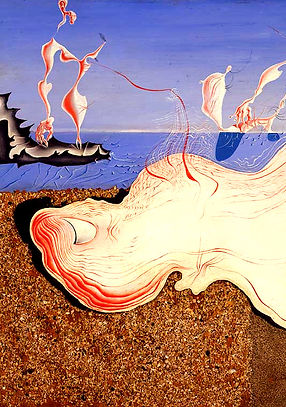
Illustration. Bather, Salvador Dali. Public Domain.
DIYA-KACHCHIYA
A coarse cloth bathing dress, which it is the duty of the dhobi to supply at the bath. It is also called DIYAREDI or DIYAPIRUWATA.
HANGALA
The PIRU-WATAYA or lent-cloth given by dhobis to KAPUWO (matchmakers) and YAKDESSO (exorcists).
PIRUWATAYA
A cloth, towel, or sheet supplied by the dhobi and returned after use.
RADAYA
A washerman of an inferior feudal grade.
RADA-BADDARA-RAJAKARIYA
The Dhobi service. It consisted of washing weekly or monthly the soiled clothes of a family and the robes, curtains, flags, and vestments of a Temple. Other duties included decorating temples for festivals and PINKAM, and private houses for weddings, YAK, or BALI ceremonies, as well as for the arrival of distinguished visitors. The dhobi was also required to provide covers for seats and tables, PIYAWILI or carpets, and DIYAREDI - or bathing dresses; and to make PANDAM torches and PANWETI wicks. He was required to attend his master on journeys carrying his bundle of clothes and bathing essentials. He would also supply fresh clothes to the duty KAPURALA weekly, to the YAKDESSA exorcist for dancing at festivals, and to the state elephants for festivals. The feudal gifts he gave consisted of a piece of wearing apparel, a SUDU-TOPPIYA (a Kandyan hat), or horns for combs. On the Sinhalese New Year, he would receive (in addition to a usual quota of sweetmeats and rice) a coin from every family member tied up in cloth. At KOTAHALU (the ceremony of a female attaining puberty), he was entitled to the cloth worn by the young woman and to her head ornaments. For the funeral, he received all the deceased's clothes, which were not permitted to be burned.
TETAMATTUWA
A towel or piece of cloth to rub the body dry after a bath, which was the responsibility of the dhobi to supply.
WIYANBENDIMA
The hanging up by the dhobi of clean clothes in temples for festivals.
Doubt

Illustration. Portrait of Paul Eluard, Salvador Dali. Public Domain.
LORD BUDDHA
“Doubt everything. Find your own light.”
Early Indigenous Tribes

Illustration. Accommodations of Desire, Salvador Dali. Public Domain.
NAGAS
Associated with the worship of snakes.
RAKSHASAS & DEVAS
Legendary tribes mentioned in the Ramayana and Mahavamsa.
VEDDAS OR WANNIYA-LAETTO
People of the forest - hunter-gatherers, cave dwellers, and keepers of honey,
YAKKAS
A native tribe is often depicted as nature-worshippers.
Elephants

Illustration. The Elephants, Salvador Dali. Public Domain.
HENDUW
An elephant-goad
NETTIMALE
The ornamental headdress of an elephant in processions.
PANIKKILA OR PANIKKALA
An elephant keeper who in ancient times had charge of temple elephants used in processions, in which service a grass-cutter assisted him; both were fed when on duty at a temple.
PANTIYA
An elephant stall, a row of buildings or a festival.
PORODDA
The collar of an elephant.
RANHILIGE
The royal howdah, in which the insignia are taken in feudal processions on the back of an elephant.
URUWITALE
A spear used at elephant kraals.
Envy

Illustration. Georgette by Rene Magritte. Public Domain.
A SRI LANKAN PROVERB
“An enemy’s punishment is his envy.”
Exile

Illustration. Homesickness by Rene Magritte. Public Domain.
SAMANTH SUBRAMANIAN, THIS DIVIDED ISLAND
“His exile had begun long before he left Sri Lanka for good."
Failure

Illustration. The dawn of Cayenne, Rene Magritte. Public Domain.
DOM FERNANDO
“Failure isn't really failure.”
Fans

Illustration. The Wheelbarrow, Salvador Dali. Public Domain.
CHAARAYA
A fly-flapper – often a yak's tail fixed to a silver or other handle, used to keep flies off the insignia of a deviyo or persons of distinction.
KULU
Winnowing fans made of bamboo.
Fate

Illustration. Study for the Decoration of the Ceiling in Pubol, Salvador Dali. Public Domain.
SHEHAN KARUNATILAKA
“Only karma grants what is yours.”
Fields

Illustration. The cultivation of Ideas, Rene Magritte. Public Domain.
GOYIGANAWA
Smoothing the bed of a field, preparatory to sowing.
HEN LAND
Sometimes called Chena cultivation land, this was used for traditional rain-fed, slash-and-burn agriculture in the dry zone.
HILEKAN
A register of fields.
ISSARA
The individual share or strip of land that was part of a range of fields cultivated in common.
LIY ADDA
The bed of a field or a terrace.
MUTTETTUW
A field belonging to a landowner (often a temple) that is cultivated jointly by tenants of various castes. The landowner was responsible for providing the seed-paddy, bearing the costs of agricultural implements, and sometimes even providing the buffaloes. The tenant’s service was reckoned not by days, but by the number of the different agricultural operations to which they have to contribute labour – the WEDAPAHA. This comprised PURAN KETUMA (first digging or first ploughing); DEKUTUMA or BINNEGUNHIYA (second digging or ploughing); WEPURURNA (sowing including the smoothing of the beds); GOYAN-KEPUMA. (reaping and stacking); and GOYAN-MEDIMA (threshing and storing). All the tenants participated in these activities and were fed by the landowner. The sowing of the seed-paddy was seen as specialised work and given to the GAMMAHE to undertake, as was irrigation.
NINDAGAMA
A village or lands in a village in the exclusive possession of a landlord.
PANGUWA
A holding, a portion, a farm – also called WANATA.
PILLEWA
A piece of elevated land adjoining a field.
PURANA
A field lying fallow, or the time during which a field lies uncultivated.
WANATA
A clearing between a cultivated land and the adjacent jungle, also known as PILLOWA.
Food

Illustration. Portrait by Rene Magritte. Public Domain.
ADUKKUKAT
Specially made food, prepared in layers, was once common in rural communities and was especially associated with Yak and Bali rituals, weddings, funerals, or grand arrivals.
ADUKKU RITUALS
In traditional rural communities, this refers to offerings made to local deities, with food arranged in a specific manner on altars.
BATTANARALA
The KAPURALA who offers the food in a temple.
BATWEDA
Work for which the workmen receive food.
DADAKUDAMAS
A compound word for meat and fish.
DAN-ADUKKUWA
Food given by a tenant of a Vihare land to the incumbent.
DAN
Food given to any priest for the sake of merit.
DURAWASAMA
The office of DUREYA or the headman of the DURAYI. The tenement of land held by their class. Their services resemble those of the GANWASAMA, the difference being that, instead of cooked provisions, they give uncooked or raw provisions and vegetables. Instead of sweet meats for the PENUMA, they give them to the landlord.
GANGATAYA
The leg of an animal killed in the chase and given to the landowner, though often he received but one leg.
GORAKA
The dried fruit of the gamboge tree. It imparts a delicate acidity to food and is chiefly used in seasoning fish.
HAY A-PEHINDUMA
Provisions given to a temple or person of rank, consisting of six SERU of rice and condiments in proportion. In ancient times, a Seru was approximately equal to one litre.
HEMA-KADA
Food offering in a Dewala that was carried by the KAPURALA (called KATTIYANA-RALA) and delivered at the door of the sanctuary to the officiating KAPURALA.
KAHAMIRIS
Saffron and chillies.
KEVILI-HELIY
Sweetmeats given as a service present.
LUNUKAHAMIRIS
Salt, saffron, and chilli. The three principal ingredients which give flavour to curry are often termed “curry-stuff".
MULTEN OR MURUTEN
Food offered daily to a Deviyo in a Dewale by a KAPURELA. The MUTTETTU fields of the Dewalaya supply the rice, and the tenants of the MALUMURA PANGUWA the vegetables. The food was cooked in the temple, often three times a day and carried with great ceremony. The Kapu family would ultimately consume it.
MURA-AMURE
A feudal term that applied to a service holding to which was attached a further holding (and service obligation) linked to the benefit of additional land attached to the MULPANGUWA – especially in the Kurunegala District.
PEHINDUM
Uncooked provisions given to a headman by low-class tenants.
TASHA MARIKKAR
“If you've never had a hopper, your life might be incomplete.”
UGAPATA
Vegetables, Jaggery, or KITUL-PENI wrapped up in leaves – often arecanut.
Friendship

Illustration. Sun Table, Salvador Dali. Public Domain.
SHAN VINCENT DE PAUL
“You my, you my, you my, you my best friend (Ay) I would be there when you call my name if we riding.”
YASMINE GOONERATNE
"Friends are like books, you use them when you need them, but u will always remember them"
Gardens

Illustration. The Taste of Sorrow, Rene Magritte. Public Domain.
GEWATU-PANAMA
A feudal rental payment for gardens.
UYANWATTA
A park, or garden. The principal garden attached to a temple or a landowner’s estate. Designated tenants carried out the planting, monitoring, and harvesting.
Ghosts

Illustration. Ghost, Rene Magritte. Public Domain.
SONALI DERANIYAGALA, WAVE
"Why do I have to be the fucking ghost?"
Governing

Illustration. The Pilgrim, Rene Magritte. Public Domain.
MAITHRIPALA SIRISENA
“There is no one in this government who listens to what I say"
Greetings

Illustration. Sheherazade, Rene Magritte. Public Domain.
AYUBOWAN
The traditional Sinhala greeting, directly translating to "May you live long" or "Long life". It is used as a warm welcoming, hello, or goodbye to express respect, goodwill, and a wish for a healthy life, often accompanied by pressing palms together near the chest.
Hair

Illustration. Automatic Beginning of a Portrait of Gala (unfinished), Salvador Dali. Public Domain.
DELIPIHIYA
A razor – that was also one of the ATAPIRIKARA or eight priestly requisites, the others being three robes; an alms bowl; a needle case; a girdle; and a filter.
EMBETTAYA
A barber.
KADAKETTA
A razor.
MAITRI RAMAKRISHNAN
"Growing up, my relationship with my hair was anything but simple"
NANU
A composition made of lime juice and other acids for cleaning hair in ancient times. In temples, it is made of especially fragrant ingredients, the chief of which is powdered sandalwood.
PANALELI
Horns cut into shape for combs and given as an offering by a person of lower rank to one of higher rank.
Hardship

Illustration. The catapult of desert by Rene Magritte. Public Domain.
DHARSHAN MUNIDASA
“Time and time again, we have been tested… and time and time again, it is the Sri Lankan heart that puts us back together.”
Aircraft

Illustration. Black Flag by Rene Magritte. Public Domain.
AIR CEYLON'S LAST SLOGAN
“Nymph of the Skies.”
ROMESH GUNESEKERA
“An aircraft cabin is a place that seems to be nowhere, but I find it steeped in the place left behind and the place ahead.”
Animals

Illustration: Salvador Dali, Elephant Trumpets. Public Domain.
COMMON FOLKLORE
Animals harbour a wealth of traditional Sinhala folk beliefs. Bats in a house imply it will soon be deserted. To look at a slender loris brings bad luck. A dog howling or scratching at the earth before a house presages illness or death, and if it sleeps under a bed, its occupant will all too soon be dead. The smell of smallpox patients attracts cheetahs. Goblins are afraid of cattle with crumpled horns. Children who are made to pass under an elephant's body become strong and are free from illness. The presence of sparrows in a house is a good sign that a male child will be born. The common babbler hops as if he were once a fettered prisoner. The red-tailed flycatcher was a fire thief, and the white-tailed one a cloth thief. A white cock brings luck and prevents black beetles from destroying a garden. Peacocks dance in the morning to honour the Sun, and should you keep them as pets, your girls will not find suitors. Snails were people who, in a previous life, used to spit at others, and spiders were fishermen. It is lucky to have ants carrying their eggs around a house. Centipedes run away when their name is mentioned. The black beetle is the messenger of death. A person who kills a cobra dies or suffers some misfortune within seven days.
MAHINDA THERO
“O great King, the birds of the air and the beasts have as equal a right to live and move about in any part of the land as thou. The land belongs to the people and all living beings; thou art only the guardian of it.”
SHEHAN KARUNATILAKA
“Do animals get an afterlife? Or is their punishment to be reborn as human?”
SHEHAN KARUNATILAKA
“There are good reasons humans can’t converse with animals, except after death. Because animals wouldn’t stop complaining. And that would make them harder to slaughter.”
Artists

Illustration: Rene Magritte, The age of enlightment. Public Domain.
ANANDA COOMARASWAMY
“The artist is not a special kind of man, but every man is a special kind of artist.”
BALI-EDURO
The creators of clay images for the BALI-MADUWA ceremony performed to propitiate the planets. The performance of Bali ceremonies is one of the principal services of tenants of the TOM-TOM beater caste.
BAMBA-NETIMA
In the processions at a DIYA-KEPEEMA a man inside wickerwork frame represents a giant. The service of carrying it in procession is called BAMBANETIMA.
LIYAWEL
Ornamental flower work in temple carvings or paintings.
NETTARA-PINKAMA
The festival focused on painting the eyes of a Buddha statue in a VIHARA. The offerings received during the ceremony were given to the painters.
ROMA TEARNE, MOSQUITO
"Now there are no priests or philosophers left; artists are the most important people in the world."
SITTARA
A painter in feudal times was usually a tenant of the smith caste. His responsibilities included mending temple images and paintings. In this arrangement, the temple would supply the pigments and food. On completion of the work, the painter would offer the head of the temple an ornamented walking stick or betel tray.
Bags

Illustration. The interpretation of dreams, Rene Magritte. Public Domain.
OLONGUWA
A long bag or sack that divided its contents into two equal portions, so that one fell before and one fell behind when the bag was slung over the shoulder.
PINGO
A traditional, dated term for a flexible pole or yoke carried across one shoulder, with loads suspended from each end. It was historically used to transport goods, such as coconuts, pots, or agricultural produce.
Pingo carriers were commonplace in the 19th and early 20th centuries. The term also refers to a measure of weight—the amount of goods that could be comfortably carried using a pingo - about twenty-five kilograms.
Bathing

Illustration. Clear ideas, Rene Magritte. Public Domain.
BOLPEN
Water used at a temple for purposes of purification.
DIYAGE
A bathroom, the creation of which and the supply of water were the responsibility of ULIAMWASAM tenants – tenants who held paddy lands belonging to temples.
NANAGEYA
A bath-house. Ahead of a visit from someone of rank, the bathhouse and ATUGE (privy) were put up at his lodging by a NILAPANGUWA tenant who had a right to cultivate but not own land.
NANU MURA MANGALYAYA OR NANUMURA MANGALLAYA)
A sacred cleansing and healing ceremonial bathing ritual that anoints a statue or sacred relic with scented herbs and flowers. It is performed at all major and many minor temples and pays homage not simply to Buddhist relics but also to Hindu ones.
PADIYA
Water to wash the feet on entering the sanctuary of a Dewala.
PENPOLA
A priest's bath.
Belonging

Illustration: Rene Magritte, Almayer's folly. Public Domain.
SAM FORE
"Inclusion means not just having a seat at the table but flipping the table itself".
SHAUN CHRISTIE-DAVID
"My mum had a rule that no matter who was at the dinner table, you never eat alone."
Blood
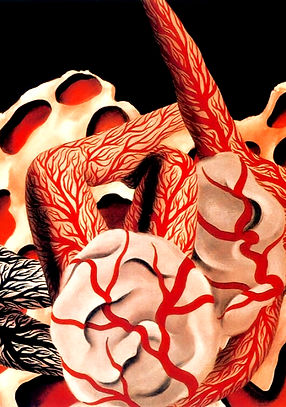
Illustration. The Blood of the World, Rene Magritte. Public Domain.
FENNEL HUDSON
"A traditional Englishman drinks tea to the point where his blood has long-since been replaced with an infusion of Ceylon, Assam, and Darjeeling."
MICHAEL ONDAATJE, THE COLLECTED WORKS OF BILLY THE KID
"Blood a necklace on me all my life."
RAJNI PERERA
“Moving is all our blood knows about.”
Buffalos

Illustration: Rene Magritte, Natural encounters. Public Domain.
BUFFALO CURD
Buffalo curd - "Mee Kiri”, Sri Lanka's best-kept secret.
HIMILA
Money given by proprietors in ancient times as hire for buffaloes employed in ploughing and threshing crops.
TAWALAMA
A pack bullock.
WIYAKOLAMILA
The hiring of buffaloes for threshing paddy.
Calander

Illustration. Salvador Dali, The Persistence of Memory. Public Domain.
MONTHS OF THE SINHALA YEAR
Duruthu - January
Navam - February
Medin - March
Bak - April (Sinhala New Year)
Vesak - May
Poson - June
Esala - July
Nikini - August
Binara - September
Vap - October
Ilmasa - November
Unduvap - December
Celebration
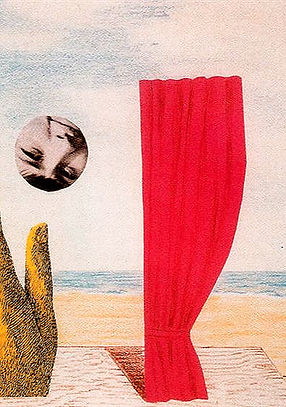
Illustration. Collage, Rene Magritte. Public Domain.
MR LYAN (RYAN CHETIYAWARDANA)
“You’ve got to celebrate on your way out.”
Christianity

Illustration. Christ of St. John of the Cross, Salvador Dali. Public Domain.
PHILIP JENKINS, THE LOST HISTORY OF CHRISTIANITY
"If early Christians could reach Ireland, there was no logical reason why they should not find their way to Sri Lanka."
ST. JOSEPH VAZ
“Christ is the Sun, we are the moon"
Coconuts

Illustration. Galatea of the Spheres, Salvador Dali. Public Domain.
COCONUT SYMBOLISM
In Sri Lankan tradition, the coconut represents surrender and beginnings. Breaking one—NARIYAL—is a common ritual to mark auspicious events like housewarmings.
KAPRUKA
The "Tree of Life” - the coconut palm.
KASAPEN
Young coconuts were given as basic provisions by landowners in feudal times.
KINISSA
A ladle, a common coconut spoon.
POLGEDIYA
The fruit of the coconut tree.
POLWALLA
A bunch of coconuts used in decorations, the supply in ancient times, formed a feudal service.
PURUKGOBA
A tender coconut branch used for decoration and known as PULAKGOBA in Sabaragamuwa or PULAKATTA in Matale.
SHANAR
A middling Tamil caste associated with coconut and palmyra cultivation, oil-pressing, and toddy tapping, who have progressed into politics and trade. They often double as non-Brahmin priests (Poosaries) in temples dedicated to Vairavar and Kali.
TELGEDI
Ripe or dry coconuts for oil extraction.
WALUMALGOBA
The cluster of young fruit, flowers, and sprouts of the coconut tree was used for decoration and supplied by tenants in feudal times.
Corruption

Illustration. Exquisite Cadaver, Salvador Dali. Public Domain.
ALLASA
A present, bribe, or fee paid on obtaining a MARUWENA-PANGUWA, the feudal tenancy given to a tenant for each cultivation year or for a period of years.
MAHINDA RAJAPAKSA
“Discipline is not revenge. The nation can only be built through commitment, discipline, and elimination of corruption.”
Crime

Illustration. The ellipse, Rene Magritte. Public Domain.
A SRI LANKAN PROVERB
“You cannot justify a crime by saying its very small crime.”
Death
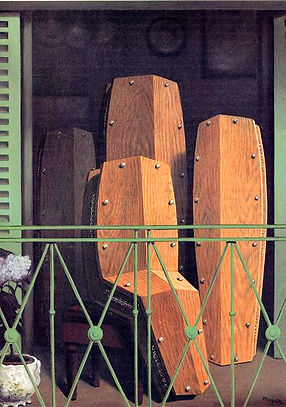
Illustration. Manet's Balcony by Rene Magritte. Public Domain.
ADHAHANA-MALUWA
A place of cremation, especially the place where the bodies of the kings of Kandy were burnt and where their ashes were buried.
ANNE RANASINGHE
“I tell her what I know
Is not true, that life
Is always better than death”
ASHOK FERREY, THE UNMARRIAGEABLE MAN
“In Sri Lanka, nothing succeeds like death - it is the ultimate validation. The man you hate in life becomes instantly your idol in death. Any neglected artist can take heart; reviled whilst alive, he only has to wait patiently for death to become the national hero he has always yearned to be.”
MICHAEL ONDAATJE, THE ENGLISH PATIENT
"Nothing will kill you, my friend. You are pure carbon."
MICHAEL ONDAATJE, THE ENGLISH PATIENT
"Death means you are in the third person."
SHEHAN KARUNATILAKA
“You used to make cracks about death when you considered it an unlikely event, as we all do, until we don’t.”
SUREN DE SARAM
“‘Everything’s just a distraction from death.”
Despair

Illustration. Elective Affinities by Rene Magritte. Public Domain.
SHEHAN KARUNATILAKA
“Despair always begins as a snack that you nibble on when bored and then becomes a meal that you have thrice a day.”
TUK-TUK WISDOM
“If you can read this, you are losing”
Differences

Illustration. The golden legend by Rene Magritte. Public Domain.
SRI LANKAN PROVERB
“If the cow gives milk as a healthy food, why ask whether she is black or white?”
Dreams

Illustration. The reckless sleeper, Rene Magritte. Public Domain.
ROMESH GUNESEKERA, NOONTIDE TOLL
"I carry more than dreams. There is so much in my head I wonder how I will ever get it out."
Ears

Illustration. La Leçon de Musique, Rene Magritte. Public Domain.
KANHENDA
An ear-pick.
PULLIMA
Ear-rings.
Emptiness

Illustration. The beyond by Rene Magritte. Public Domain.
RU FREEMAN, A DISOBEDIENT GIRL
"They are empty the way only things that contain too much can be."
Epidemics

Illustration. Melancholy Atomic, Salvador Dali. Public Domain.
ANKELIYA
An ancient ceremony of pulling horns or forked sticks to propitiate Pattini-deviyo during epidemics. However, it was often regarded more as a village sport than a religious ceremony. The Pattini-deviyo is a revered guardian goddess worshipped by both Sinhalese Buddhists and Tamil Hindus for protection, health, and fertility. According to ancient legends, the practice reenacted a scene in which the Deviyo and her husband Palanga took sides, picking flowers with the forked sticks - the husband standing at the top and the wife at the foot of a tree.
Villagers, who by custom would already belong to one side or the other (UDA and YATI-PIL), would meet in a central spot in the midst of a group of villages set apart for the particular purpose, called ANPITIYA, on a day earmarked as auspicious by a priest, who would carry a HALAN bracelet. The two sides would select their own horn or forked stick ; entwining them, with one tied to a
stake or tree, and the other to a rope, which was pulled by the two parties till one or other of the horns or sticks broke. If the side favoured by the priest won, it was regarded as a good omen for the ending of the epidemic. The ceremony closes with a triumphal procession to the nearest Dewale.
Experience

Illustration. Wreckage of the shadow by Rene Magritte. Public Domain.
RU FREEMAN, A DISOBEDIENT GIRL
And we must experience things without condemning them, because if we condemn them, then we are becoming too involved."
Faithfulness

Illustration. Midnight marriage, Rene Magritte. Public Domain.
THE LORD BUDDHA
"Health is the greatest gift, contentment the greatest wealth, faithfulness the best relationship".
TUK-TUK WISDOM
“No girls…Only my wife”
Farwells

Illustration. High Society, Rene Magritte. Public Domain.
NAYOMI MUNAWEERA, WHAT LIES BETWEEN US
"Leaving is an act that cannot be undone."
V.V. GANESHANANTHAN, BROTHERLESS NIGHT
"I go only to return," I said because Tamil has no words for last goodbyes."
CASUAL FAREWELL IN SRI LANKAN ENGLISH
"Hi-bye friend."
Festivals

Illustration. The Lugubrious Game, Salvador Dali. Public Domain.
ALUT-AWRUDU-MANGALYAYA
A festival of the Sinhalese year that falls in early April.
ALUT-SAL-MANGALYAYA
The festival of the first fruits; the harvest festival.
AWRUDU-PANTIYA
The term for the New Year festival, as used in the Kurunegala District.
KATTIYA
A general term for a festival; in particular, it was applied to the festival of lights in Nov. Dec., called KATTIMANGALAYA.
MANGALYAYA
A festival. The four principal festivals are AWURUDU (old year), NANUMURA (new year), KATTI (feast of lights) in November, and ALUTSAL (harvest) in January. Repairs, cleaning, decorations, processions, and lights accompanied the festival. Land disputes would traditionally be settled, annual officers appointed, and dues paid to landlords.
NANUMUTRA-MANGALYAYA
The festival immediately following the Sinhalese New Year, when purification with NANNU is performed. Nanu was made of lime juice and sandalwood.
SATARA-MANGALYAYA
The four principal festivals in the year.
Fish

Illustration. Homage to Alphonse Allais by Rene Magritte. Public Domain.
KARAWALA
A term for dried fish, used by feudal Moor tenants.
KUDAMASSAN
A small fish cured for curry.
NAYOMI MUNAWEERA, ISLAND OF A THOUSAND MIRRORS
"Those less fortunate eat dried fish while the truly destitute fight with the spiny shells of crabs or lobsters.”
A SRI LANKAN PROVERB
“Use the small fish as bait to catch the bigger fish.”
TITTAYAN
A kind of small freshwater fish with a bitter taste. It was dried and given with other articles as provisions in feudal times.
Forgiveness

Illustration. The Hand, Salvador Dali. Public Domain.
SHEHAN KARUNATILAKA
“Father, forgive them, for I will never.”
Funerals

Illustration. Perspective: Madame Recamier by David, Rene Magritte. Public Domain.
MINNETTE DE SILVA
“I wish more people would make time and come and see me here, rather than come for my funeral.”'
Gay

Illustraiton. The Prince of Love, Salvador Dali. Public Domain.
SHEHAN KARUNATILAKA, THE SEVEN MOONS OF MAALI ALMEIDA
“I am not a queer, you are not a faggot, we are not ponnayas. We are beautiful men who like handsome boys."
God

Illustration. God is Not a Saint, Rene Magritte. Public Domain.
ARTHUR C. CLARKE
"God was just this black void that we cried into."
ARTHUR C. CLARKE
"It may be that our role on this planet
is not to worship God--but to create him."
KATARAGAMA DEVIYO OR KATARAGAMA GOD
A revered guardian deity regarded as a powerful protector of Buddhism, the nation, and its people. Often identified as Skanda or Kartikeya, he is worshipped by Buddhists, Hindus, and Vedda people, particularly at the Ruhunu Maha Kataragama Devalaya.
MAHAKAT OR MEHI-KATHA
The Earth Goddess or the Earth itself. In legends, she supports the world on one of her thumbs and, when weary, shifts it to the other, which causes an earthquake.
MICHAEL ONDAATJE, ANIL'S GHOST
"Jung was absolutely right about one thing. We are occupied by gods. The mistake is to identify with the god occupying you."
SHEHAN KARUNATILAKA
“Thank god there is no god. Because to believe in him would be to acknowledge he doesn’t like me much.”
SHEHAN KARUNATILAKA
“Why should a Creator watch over you? Wasn’t creating you enough?”
SHEHAN KARUNATILAKA
“It’s difficult to know God’s face if you don’t even know your own.”
S.J. SINDU, BLUE-SKINNED GODS
"Gods were supposed to be kind and forgiving. Unlike the Christian concept of eternal damnation, Hindus believed in paying for the sins you commit to absolve yourself of them."
S.J. SINDU, MARRIAGE OF A THOUSAND LIES
"Even if the gods are real, I don't think they can liberate us."
TUK-TUK WISDOM
“No god no peace, know god, know peace”
Granaries

Illustration. Wheat Ear, Salvador Dali. Public Domain.
ATUWA
A Granary.
BANDARA-ATUWA
A feudal landowner’s granary.
BISSA
A term in use in the Kegalle District for a round granary made of wickerwork daubed with mud.
HAMBA-ATUWA
The granary belonging to a temple or the king in ancient times.
KAMATA
A threshing-floor.
LIY ANABATA
Food given by a cultivator to the LEKAM on duty at a threshing floor.
MADU-PIYALI
The nuts of the MADUGAHA. broken into pieces, dried, and converted into flour for food. The MADUGAHA tree (Cycas zeylanica) is a native cycad with palm-like leaves, known for its medicinal and ornamental value and for its large edible seeds.
Grief

Illustration. Landscape by Rene Magritte. Public Domain.
ANNE RANASINGHE
“Don’t cry
Because the pot is broken
It had long been cracked.”
ASHOK FERREY, THE UNMARRIAGEABLE MAN
“Grief to me is a dish best eaten alone, in a cold room.”
S.J. SINDU, MARRIAGE OF A THOUSAND LIES
"Grief is an impossible meal, so we cut it up into little pieces, dress it in ritual, and take it like a pill."
SONALI DERANIYAGALA, WAVE
"How hideous, that there should be a pecking order in my grief."
Handkerchief

Illustration. Untitled, Salvador Dali. Public Domain.
IRILENSUWA
A striped handkerchief given as a sign of favour in feudal times by tenants of the tom-tom beater caste.
Ambition

Illustration: Rene Magritte, Perpetual motion. Public Domain.
TUK-TUK WISDOM
“Who Flies Not High, Falls Not Low”
Approval

Illustration: Rene Magritte, Fine realities. Public Domain.
FANTASTIC IN SRI LANKAN ENGLISH
“Patta/Patas.”
IT'S ALRIGHT IN SRI LANKAN ENGLISH
“Shape!”
GOOD VALUE IN SRI LANKAN ENGLISH
“Fully worth.”
Astrologers

Illustration: The Alchemist, Salvador Dali. Public Domain.
AWRUDU-WATTORUW
A chit given by the astrologer showing the hour when the new year commences, and its prognostics.
Bananas & Plantains

Illustration: Sorcery, Salvador Dali. Public Domain.
ATHKOLAYA
A piece of a plantain leaf that is used instead of a plate. In feudal times, there was a special tenant whose job was to supply it for a temple’s daily service.
KEWUN-KESELKAN
Sweetmeats and ripe plantains.
KEHELMUW
A flower of the plantain.
MALU-KESELKEN
Green unripe plantains are used for curries.
POPULAR SLOGANS FOR SELLING BANANAS IN SRI LANKA
"Ambul Kesel: The True Taste of Lanka."
"Stay Fit, Eat More Local Bananas."
"Power Up with Locally Grown."
"Peel the Joy."
RAMBATORANA
An arch in which plantain trees form the chief decoration.
TATUKOLA
Pieces of plantain leaves that are used as plates.
Beauty

Illustration: Face of Mae West Which May Be Used as a Surrealist Apartment,
Salvador Dali. Public Domain.
RANI MANICKA, THE RICE MOTHER
"Excessive beauty is a curse. Happiness refuses to share the same bed as beauty."
SIGIRIA GRAFFITI: 7th - 8th CENTURIES
“We spoke, but they did not answer
Those ladies of the mountain
They did not give us
The twitch of an eyelid
The girl with the golden skin
Enticed the mind and eyes.
Her lovely breasts caused me to recall
Swans drunk with nectar.”
TUK-TUK WISDOM
“If you’re cute, you can call me baby”
Betel

Illustration. Mae West Lips sofa, Salvador Dali. Public Domain.
Betel – the chewing of its nuts and the presentation of its leaves - is a cultural tradition that dates back over 3,500 years across the Indian subcontinent. Betel’s primary compound – arecoline – is fondly thought to stimulate alertness and energy, even to the point of creating mild euphoria, a condition that probably blots out its known health downsides: mouth cancer, heart disease, and diabetes.
It is easily prepared. The DEHET-GOTUW, or betel nut, is wrapped in a betel leaf, or NIYAKOLA, and slaked lime paste, cardamom, cloves, and sometimes dates and tobacco are added for flavour. The leaf is folded into a small pouch, chewed, and the red saliva is spat out. Occasionally, TAMBALA leaves from a creeper are used instead.
It is popular at all levels of society and is especially prominent at weddings, the New Year, and other important celebrations. Presenting its leaves to elders, professionals, astrologers, the ancient kings, and present-day leaders is a familiar sign of respect. In feudal times, this included BULAT-ATA, where a roll of betel consisting of 40 leaves would be presented to a landowner on rent day, or BULAT-HURULLA, which marked the fee paid by tenants to a temple for MARUVENA PANGUWA land. The very act of supplying betel for such occasions was termed DALUMURE. Some tenants, with DALUMURA-PANGUWA tenancies, were required to supply a certain quantity of betel leaves weekly, or for important ceremonies and for the consumption of duty officers and priests. The kings of Kandy had significant betel plantations, staffed by officers, gardeners, and carriers, and centred on XINDA VILLAGES, such as Meemure.
When a roll of betel leaves, was given to a priest, it was often placed on an ILLATTATTUWA. This traditional betel tray was a feudal requirement for carpenters and wood carvers to create. Elaborate CHUNAM BOXES, or KILLOTAYA, were created by goldsmiths to store the lime (chunam) used for betel leaf chewing, and the act of offering both betel and chunam at temples was known as KARANDU-HUNU.
Borders

Illustration: Rene Magritte, On the Threshold of Liberty. Public Domain.
LEAH LAKSHMI PIEPZNA-SAMARASINHA
“This border is rotten meat, a hallucination, a wavering line, a stupid idea. Can’t we blink and it'll be gone?”
Buildings

Illustration. Living on The Moon, Salvador Dali. Public Domain.
PELELLA
A screen made of leaves and branches to serve as a wall in temporary buildings.
BATAKOLA
The leaves of a small bamboo species that were used for thatching buildings.
ATUGE
A temporary shed or outhouse for a toilet.
ATUPANDALAYA
A temporary shed made of leaves and branches.
MAHA-SALAWA
The chief or great hall.
MANDAPPAYA
A covered court or veranda.
IDANGE OR IDAMA
The principal building where important visitors were lodged in a feudal village.
KATUPELALI
Rough screens made of branches that act as substitutes for walls in a temporary building.
PURAGEYA
The scaffolding of a building or the temporary shed put up to give shelter to the workmen and to protect the permanent structure during construction.
BANDARA
A building that belonged in feudal times to a place, though its use widened to include the buildings of all landowners.
WALAWWA
A respectful term for the residence of a person of rank. The manor-house.
Caste
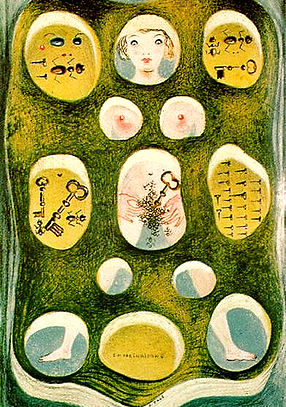
Illustrationn. Combinations (or The Combined Dalinian Phantasms; Ants, Keys, Nails), Salvador Dali. Public Domain.
ASHOK FERREY
“In Sri Lanka, the people you lived amongst, the people you went to school with, the people in whose houses you ate, whose jokes you shared: these were not the people you married. Quite possibly, they were not your religion. More to the point, they were probably not your caste. This word, with its fearsome connotations, was never, hardly ever used. But it was ever-present: it muddied the waters of Sri Lanka's politics; it perfumed the air of her bedchambers; it lurked, like a particularly noxious relative, behind the poruwa of every wedding ceremony. It was the c-word. People used its synonym, its acronym, its antonym-indeed, any other nym that came to mind - in the vain hope its meaning would somehow go away. It did not. But if the people you chose to associate with were the very ones you could not marry, then the ones you did marry were quite often people you would not dream of associating with if you had any choice in the matter.”
SWARNAKANTHI RAJAPAKSE
According to the Buddha's doctrine that they believed in, it was not the caste that defined a person as high or low. It was one's deeds that mattered.”
Character

Illustration. Shirley Temple, Salvador Dali. Public Domain.
SHARANYA MANIVANNAN, THE HIGH PRIESTESS, NEVER MARRIES
"It is astonishing how strong you become when you've spent a lot of time being other people's weaknesses."
SHARANYA MANIVANNAN, THE QUEEN OF JASMINE COUNTRY
"There are no homes with rooms large enough for the wingspan of a woman like me, and so no one will ask me to enter his."
Civil War

Illustration. Study for ‘Honey is Sweeter than Blood’, Salvador Dali. Public Domain.
NEW LINES MAGAZINE
"Villages vanished, cities were shelled and generations grew knowing only suspicion. The world looked away, mistaking exhaustion for peace."
ROMA TEARNE, MOSQUITO
"Has there ever been a country that, once colonised, avoided civil war?"
Colour

Illustration. The good season, Rene Magritte. Public Domain.
BARBARA SANSONI
“Colour in geometric proportion, coarse and fine warp and weft textures are the characteristics of this handwoven cloth
And we call it the Barefoot “Reddha”
Use it on your table.
Use it on your sofa,
It’s an instant love-in
And a lightning dress-up
Now a magic carpet -
an entire way of life
A reddha is a happening
you can’t afford to miss.”
ROMA TEARNE, MOSQUITO
"Grey has no agenda. . . . Grey has the ability, that no other colour has, to make the invisible visible."
Cricket Terms

Illustration. The secret player, Rene Magritte. Public Domain.
BUNSEN
Refers to a pitch that spins heavily, originating from Cockney rhyming slang (Bunsen Burner = Turner) and often mixed with local Sinhala phrases during commentary.
DOLLY
An extremely easy catch.
GO THE TONK
Aggressive, slogging style of batting.
JAFFA
A term for an exceptional, unplayable delivery from a bowler.
NICKED OFF
When a batsman edges the ball to the keeper or slips.
RABBIT/BUNNY
A lower-order batsman who cannot bat well.
RAIN PERERA
A humorous, commonly used name for rain interruptions during Sri Lankan matches, treating rain as a fictional "all-rounder".
ROAD
A very flat, easy pitch for batting.
TAPTAAN
The team captain.
Culture

Illustration. The familiar objects, Rene Magritte. Public Domain.
PANDIT W.D. AMARADEVA
“I want cultures of all lands to blow into my house as freely as possible, but I refuse to be blown off my feet.”
Debating
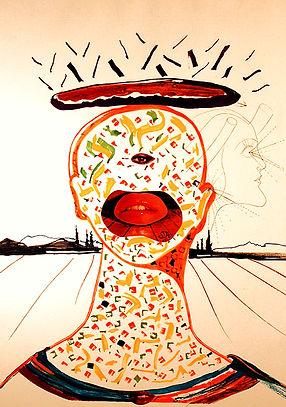
Illustration. Salvador Dalí, Untitled. Public Domain.
A SRI LANKAN PROVERB
“A good tongue is a good weapon.”
Devils

Illustration. Black Devil - The Divine Comedy, Salvador Dali. Public Domain.
BALI
A traditional, ritualistic offering or "sacrifice" (SHANTHIKARMA) to appease planetary deities and so avert evil influences, sickness, or misfortune. The ceremony involves the sculpting of temporary clay figures representing planets, accompanied by rhythmic dancing, singing, and incantations to treat or exorcise bad influences. It is believed that specific planets control specific life aspects, and the Bali ritual balances these forces through symbolic offerings with different areas in the country presenting the tradition differently – including UDARATA BALI (Up-country), PAHATARATA BALI (Low-country), SABARAGAMU, and UVA.
DEWOL OR DEWOL-YAKUN
The word given to foreign devils said to have come from beyond the seas and who, according to tradition, landed at the seaside village of Dewundare near Matara and proceeded from there to Sinigama near Hikkaduwa. Pilgrims resort to either place and perform there the vows made by them in times of sickness and distress.
KANKARIY
A devil ceremony.
ROMESH GUNESEKERA
“Sri Lanka was a land where verses were more powerful than armies, and where a little girl could summon demons.”
SHEHAN KARUNATILAKA
“Do not be afraid of demons; it is the living we should fear. Human horrors trump anything that Hollywood or the afterlife can conjure. Always remember this when you encounter a wild animal or a stray spirit. They are not as dangerous as you.”
SRI LANKAN PROVERB
“If the devil is your godfather, you will be welcome in hell.”
WALIYAKUMA OR WEDIYAKUMA
The devil-dance after a DIYAKEPUMA, the ceremony of cutting water with golden swords by the priest at a ford or pond at the close of the Perehera in July or August
YAK OR YAKKAS
Wicked or mischievous spirits who bring sickness, bad luck, or suffering to humans. Some, however, act as protective forces, such as the Gara Yaka, which is believed to cleanse bad energy and guard against curses. When someone is sick, it is believed that a YAKA is responsible. An exorcist (EDURA) is hired to perform a devil dance (TOVIL) or Sanni Yakuma to appease, intimidate, or drive out the demon. The faces of the Yakka are depicted on colourful, exaggerated masks used in the dances. In the earliest myths of Sri Lanka, the Yakkas were believed to be an indigenous tribe conquered by the founder of the Sinhalese race, King Vijaya.
YAKDESS
In ancient times, this referred to a tenant of the tom-tom beater caste who performed Devil ceremonies.
YAKGE OR YAKMADUWA
The shed in which a devil ceremony is performed.
YAKUN NATIMA OR TOVIL
A devil dance exorcism ritual aimed at healing physical and mental ailments believed to be caused by demons (YAKKU). The primary goal of SANNI YAKUMA (the most common type of devil dance) is to cure eighteen specific types of diseases, with each disease caused by a specific demon, by summoning and chasing them away. Dancers wear intricate, colourful masks made of KADURU wood, representing various demons (RAKSHA) to frighten or appease them. A KATTADIYA (exorcist/priest) conducts the ceremony, which can last all night and involves offerings to the spirits, hypnotic dance movements, and dramatic reenactments of possession.
Doors

Illustration. Early morning, Rene Magritte. Public Domain.
MICHAEL ONDAATJE, COMING THROUGH SLAUGHTER
"The right ending is an open door you can't see too far out of. It can mean exactly the opposite of what you are thinking."
SHEHAN KARUNATILAKA
“I know now that doors open as quickly as they close. That nothing very good or very bad lasts for very long.”
YOGASWAMI
“Why do you want to open the outside door when there is an inside door?”
Drums & Drummers

Illustration. Board of Demented Associations (Fireworks), Salvador Dali. Public Domain.
BERAVA
The Tom-Tim beater or drumming caste, thought to be South Indian migrants from the Paraiyar community, and, in the grand caste pecking order, considered to be from one of the lower drawers. Alongside drumming, they added many other cultural practices, including singing and dancing, which naturally led to rituals to appease bad spirits.
DAWULA
A traditional, barrel-shaped drum used across the island but most notably in the Sabaragamuwa province, at Buddhist ceremonies, traditional dance, and cultural processions. It is made from wood – usually
kittul or coconut - decorated with brass strips and covered with cattle hide. It is played using a combination of techniques: the player strikes one side with a stick (KADIPPU) and the other side with an open hand. It is often accompanied by the THAMMATTAMA, a twin-faced drum played with two sticks.
DAWULKARAYA
A feudal tenant of the tom-tom beater caste, playing on a DAWULA drum at the daily service of a VIHARE or a DEWALE, and at the festivals.
DAWUL-PANGUWA
The tenement of feudal tenants of the tom-tom beater caste – also known as HEWISIKARAYA. In temples, their service was referred to as the PITA-KATTALE (outdoor service). At the daily TEWAWA religious service, at festivals, PINKAMS, and on journeys to these places, they would beat the HEWISI tom-toms. When on duty in a temple, they had to watch the temple, sweep, and clean the premises, gather flowers for offerings, and fetch BOLPEN (water for temple use). A HEWISIKARAYA’S services were often required for weddings, funerals, YAK, and BALI ceremonies, and on state occasions. The caste was also employed in weaving cloth.
MADDILIY
A Tamil drum used in the Kataragama Dewale in the Badulla District.
MAGUL-BERE
The opening tune that was beaten on tom-toms at the regular HEWISI (musical service) at daily temple services and at festivals.
PANIKKIYA
The feudal headman of the tom-tom beater caste, but also a barber.
PINBERA
The beating of a tom-tom for merit during almsgivings and on a poya day, PINKAM – a pinkam being a communal Buddhist ceremony designed to accumulate spiritual merit (pin). The practice involved rituals, offering alms to monks, chanting, processions, and serving as a form of social gathering.
WAJJANKARAYA
A TOM-TOM-beater, and a general term in ancient times for a temple musician, one with responsibility for the DAWULA (common drum); the TEMETTAMA (kettle drum); the BERAYA (a drum longer than a DAWULA); the TALIYA (cymbals); and the HORANEWA (trumpet).
TEMMETTAMA
A kettle-drum. One of the five musical instruments of a temple.
TEMMETTANKARAYA
A tenant who played the TEMMETTAMA ( a twin drum) and who belonged to the TOM-TOM beater caste. They provided their feudal services at daily temple ceremonies and festivals, PEREHERAS and PINKAMA; at weddings, YAK and BALI ceremonies; at funerals; and on journeys on state occasions.
TOM-TOM BEATER
A traditional drummer, often associated with specific castes, who plays drums during Buddhist temple rituals, funerals, processions, and traditional devil dances.
They are responsible for creating the necessary rhythms for ceremonies, including devil-dancing. In feudal times, they were also responsible for making public announcements on behalf of kings.
UDAKKIYA
A small drum carried in the hand and used to play dance music; its use was not restricted to any particular caste in feudal times.
Education

Illustration. The present by Rene Magritte. Public Domain.
A SRI LANKAN PROVERB
“The one who teaches is the giver of eyes.”
Enemies

Illustration. Iesus a Satana tentatur (Mark 1:13), Salvador Dali. Public Domain.
ROBERT KNOX’S KANDYAN PROVERBS
"To lend another makes him become an enemy."
VELUPILLAI PRABHAKARAN
“Traitors are more dangerous than enemies.”
YOGASWAMI OF JAFFNA
“You are your own friend; you are your own enemy.”
Evil

Illustration. The blow to the heart by Rene Magritte. Public Domain.
ARTHUR C. CLARKE, CHILDHOOD'S END
"Evil men could be destroyed, but nothing could be done with good men who were deluded."
SHEHAN KARUNATILAKA
“Good sits in a corner, collects a cheque, and pays a mortgage. Evil builds empires.”
Exploration

Illustration. Forbidden literature (The use of the Word), Rene Magritte. Public Domain.
ARTHUR C. CLARKE
"The only way of discovering the limits of the possible is to venture a little way past them into the impossible."
ARTHUR C. CLARKE,2001: A SPACE ODYSSEY
"Discovery was no longer a happy ship."
Family

Illustration. The First Days of Spring, Salvador Dali. Public Domain.
FIRST FEMALE COUSIN IN SRI LANKAN ENGLISH
“Cousin-sister.”
FIRST MALE COUSIN IN SRI LANKAN ENGLISH
“Cousin-brother.”
MICHAEL ONDAATJE
I am the cinnamon
peeler's wife. Smell me."
MICHAEL ONDAATJE, ANIL'S GHOST
"We need parents when we’re old, too."
NAYOMI MUNAWEERA
"They hate me because I am the worst thing possible. I am the bad mother.”
NAYOMI MUNAWEERA
“In Sri Lanka, when two strangers meet, they ask a series of questions that reveal family, ancestral village, and blood ties until they arrive at a common friend or relative. Then they say, "Those are our people, so you are our people." It's a small place. Everyone knows everyone.
TUK-TUK WISDOM
“If you are bad, I'm your dad”
Fashion

Illustration. Philosophy in the bedroom, Rene Magritte. Public Domain.
AMESH WIJESEKERA
“Owning expensive clothes won't make you fashionable.”
Feudal Tenants

Illustration. The Architectonic Angelus of Millet, Salvador Dali. Public Domain.
ATTUMARUWA
A feudal letting in which a field was pass into the possession of different families over a period of years. Death, inheritance rights, and illness inevitably made the system so complicated as to be almost unworkable.
BATWADANARALA
A feudal designation often associated with the BATHGAMA caste, who were responsible for agricultural labour and for providing services to the royal court, including supplying rice and other food in the Kandyan provinces.
DALUPATHKARAYA OR PELKARAYA
A feudal term for a sub-tenant or a garden tenant who works land owned by a MULPANGUKARAYA.
DIWEL
A feudal term for hire or remuneration for tenancy services.
LEKAM PANGUWA
The LEKAM tenant was responsible for overseeing a landowner’s working parties and harvest. His somewhat random other responsibilities included accompanying him on important journeys, attending to him with medicine when he was sick, and guarding his house in his absence.
MANANNA
The office of MANANNA, or the holding, was held by the MANANA people; their primary service was to measure out paddy to be pounded, as well as the paddy brought in from the fields and the rice brought in after being pounded. Over time, the office came to be held by the VELLALA castes and absorbed other duties such as putting up privies, mudding walls, carrying palanquins and baggage, ADUKKUKAT provisions, and serving as torch festival bearers. Other duties were further piled upon the office - the MANANNA was often the VIDANE or headman’s messenger, and had to keep watch at the threshing floor, take care of buffaloes and assist in the collection of the dues.
MARUWENA-PANGUWA
A feudal holding of land given to a tenant on a temporary basis, usually for a specific cultivation year or for a limited period of years. Unlike a PARAVENI PANGUWA, which is a hereditary holding held in perpetuity, a MARUWENA PANGUWA can be taken back by the landlord after the agreed period.
MULPANGUWA
A specific portion of feudal land granted to a person in exchange for specific services rendered to the temple or for a share of the produce
MUTTETTU
A feudal land tenure system where land was held in exchange for services provided to a temple (Viharaya) or a king.
NAKATI
A collection of middling feudal Kandyan kingdom service castes whose place in the pecking order was above that of the lowest castes – the Kinnara, Ahikuntika, or Rodi. Their independence was limited and their services directed to meeting the needs of such higher castes as the Radala and Govigama.
NINDAGAM
The ancient hereditary land tenure system that referred to land and villages the king granted to officials and courtiers, distinct from Viharagam tenure (temple lands) or Dewalagam tenure (shrine lands). The individuals living in such villages became tenants of the individual to whom the land had been granted and were obligated to provide set feudal services to him. The system was abolished in 1968, and the tenants became absolute landowners of the land they once farmed for the hereditary owner.
NILAKARA YA
A tenant typically responsible for carrying out menial duties in feudal times.
NILAPANGUWA
A feudal term to describe those tenants, usually in the Kandyan kingdom, who had the right to cultivate – though not own - a plot of land.
NILAWASAMA
The tenement held by the NILAWASAM tenants. Their services embraced a dizzying array of domestic and outdoor work – including the supplying of fuel and water, the pounding of paddy, extracting oil, mudding walls and floors, dragging of timber, preparing clay, blowing the bellows for the smit, breaking lime stones, cutting of banks and ditches, putting up fences, clearing gardens, sweeping out courtyards, assisting in thatching, carrying of palanquins. Such tenants were from the lower castes, especially the Vellala caste.
PANGUKARAYA
The feudal holder or tenant of a share of land.
PARAVENI PANGUWA
A feudal share of land inherited or held in perpetuity.
PELKARAYA
A sub-tenant.
ULIAMWASAM
Feudal tenants who held paddy lands belonging to temples.
WASAMA
An office or feudal service holding.
Flowers

Illustration. The tomb of the wrestlers by Rene MagrittePublic Domain.
ARANGUWA
An ornamental arch decorated with flowers or tender leaves of the coconut tree.
DOTALU-MAL
The flowers of the DOTALU-TREE, a small species of the arecanut tree, are used in decorations.
MALABANDINA-RAJAKARIYA
The term in use in the Matale District for the service of putting up a pole tied with flowers for the Perehera.
MALASUNGE
A small detached building at a Vihare or temple to offer flowers in. These buildings were also found attached to private houses, where they served as private chapels.
MALWATTIYA
A basket or tray of flowers. One of the feudal duties of a tenant at a temple was to supply a basket of flowers in the morning and evening for offering in front of the image of Buddha or in front of the shrine.
SRI LANKAN VEDDA SAYING
"We teach children never to pluck a flower or a leaf from a tree if you don't have any use for it, and never cut trees near a river stream because it will dry up".
Freedom

Illustration. The human condition, Rene Magritte. Public Domain.
CHAMILA GAMAGE
“How could we say that we are free humans when our thoughts and actions are not ours?”
Future

Illustration. The Ghost of Vermeer van Delft which Can Be Used as a Table, Salvador Dali. Public Domain.
PRIYA RAGU
"I’m just going to walk into the future without having any expectations."
Geography

Illustration. The Sense of Speed, Salvador Dali. Public Domain.
ARTHUR C. CLARKE.
"Sri Lanka is a tear-shaped island of mystery and beauty, a paradise on Earth."
MICHAEL ONDAATJE.
"This little teardrop off the southern tip of India is home to one of the oldest civilisations in the world."
MICHAEL ONDAATJE, THE ENGLISH PATIENT
"Do you understand the sadness of geography?"
ROMESH GUNESEKERA
“Sri Lanka is an island that everyone loves at some level inside themselves. A very special island that travellers, from Sinbad to Marco Polo, dreamed about. A place where the contours of the land itself form a kind of sinewy poetry.”
YUDHANJAYA WIJERATNE (NUMBERCASTE)
"Sri Lanka is a beautiful little island nation parked perilously close to India; a little too hot, a little too humid, and perhaps too expensive, but to its credit are fantastic beaches, strangely melancholy hills, and the ruins of kingdoms past.”
Gossip

Illustration. The triumphant march by Rene Magritte. Public Domain.
SHEHAN KARUNATILAKA, THE SEVEN MOONS OF MAALI ALMEIDA
“I don't listen to rumours. I only spread them.”
Gravity

Illustration. The infinite recognition, Rene Magritte. Public Domain.
GAYENDRA ABEYWARDANE, CROCODILE CHAMBER
"The physics of gravity was not reserved only for large celestial objects to efficiently exert."
Growing Up

Illustration. Polar light, Rene Magritte. Public Domain.
ANANDA MAITREYA
“I feel like growing up is just the process of losing pieces of yourself…”
HENRY STEEL OLCOTT
“Physiologically speaking, man’s body is completely changed every seven years.”
Happiness

Illustration. Pure reason by Rene Magritte. Public Domain.
ANUK ARUDPRAGASAM, THE STORY OF A BRIEF MARRIAGE
"Things just happen and we have to accept them. Happiness and sadness are for people who can control what happens to them."
bottom of page